Webb is able to see right through and into massive clouds of dust that are opaque to visible-light observatories like Hubble, where stars and planetary systems are being born.

Star Lifecycle

Pillars of Creation

The Pillars of Creation in the Eagle Nebula captured in visible light by Hubble. Stellar nurseries are hidden within the towers of dust and gas. Credit: NASA/ESA/Hubble Heritage Team (STScI/AURA)/J. Hester, P. Scowen (Arizona State U.)
Inside the Pillars of Creation
While this image is spectacular, there are actually stars that Hubble can't see inside those pillars of dust. And that's because the visible light emitted by those stars is being obscured by the dust. But what if we used a telescope sensitive to infrared light to look at this nebula?
Near Infrared View

The Pillars of Creation in the Eagle Nebula captured in infrared light by Hubble. The light from young stars being formed pierce the clouds of dust and gas in the infrared. Credit: NASA, ESA, and the Hubble Heritage Team (STScI/AURA)
The next image is another Hubble view, but this time in near-infrared. In the infrared more structure within the dust clouds is revealed and hidden stars have now become apparent. (And if Hubble, which is optimized for visible light, can capture a near-infrared image like this, imagine what Webb, which is optimized for near-infrared and 100x more powerful than Hubble, is doing!)
Mystic Mountains
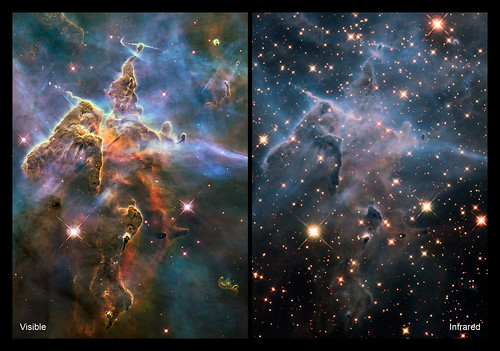
Comparison of the Carina Nebula in visible light (left) and infrared (right), both images by Hubble. Credit: NASA/ESA/M. Livio & Hubble 20th Anniversary Team (STScI)
Another nebula, the "Mystic Mountains" of the Carina Nebula, shown in two Hubble images, one in visible light (left) and one in infrared (right).
In the infrared image, we can see more stars that just weren't visible before. Why is this?
How Do Infrared Cameras Work?
We can try a thought experiment. What if you were to put your arm into a garbage bag? Your arm is hidden. Invisible. But what if you looked at your arm and the garbage bag with an infrared camera? Remember that infrared light is essentially heat. And that while your eyes may not be able to pick up the warmth of your arm underneath the cooler plastic of the bag, an infrared camera can. An infrared camera can see right through the bag!

Man in visible light. Credit: NASA/IPAC

Man in infrared light. Credit: NASA/IPAC
And this is how the infrared telescope works as well. It sees the heat or infrared light being emitted by the stars within the cooler dust clouds.
Star-Forming Region

ALMA image of the young star HL Tau and its protoplanetary disk. This best image ever of planet formation reveals multiple rings and gaps that herald the presence of emerging planets as they sweep their orbits clear of dust and gas. Credit: ALMA (NRAO/ESO/NAOJ); C. Brogan, B. Saxton (NRAO/AUI/NSF)
The Dusty Cocoons of Star and Planet Formation
Webb's amazing imaging and spectroscopy capabilities is allowing us to study stars as they are forming in their dusty cocoons. Additionally, it is able to image disks of heated material around these young stars, which can indicate the beginnings of planetary systems, and study organic molecules that are important for life to develop.
IN DEPTH
Key Questions
Webb is addressing several key questions to help us unravel the story of the star and planet formation:
- How do clouds of gas and dust collapse to form stars?
- Why do most stars form in groups?
- Exactly how do planetary systems form?
- How do stars evolve and release the heavy elements they produce back into space for recycling into new generations of stars and planets?
Webb's Role in Answering These Questions

Infrared Spitzer image of a star-forming region. Credit: NASA/JPL-Caltech/ Harvard-Smithsonian CfA
To unravel the birth and early evolution of stars and planets, we need to be able to peer into the hearts of dense and dusty cloud cores where star formation begins. These regions cannot be observed at visible light wavelengths as the dust would make such regions opaque and must be observed at infrared wavelengths.
Stars, like our Sun, can be thought of as "basic particles" of the Universe, just as atoms are "basic particles" of matter. Groups of stars make up galaxies, while planets and ultimately life arise around stars. Although stars have been the main topic of astronomy for thousands of years, we have begun to understand them in detail only in recent times through the advent of powerful telescopes and computers.
A hundred years ago, scientists did not know that stars are powered by nuclear fusion, and 50 years ago they did not know that stars are continually forming in the Universe. Researchers still do not know the details of how clouds of gas and dust collapse to form stars, or why most stars form in groups, or exactly how planetary systems form. Young stars within a star-forming region interact with each other in complex ways. The details of how they evolve and release the heavy elements they produce back into space for recycling into new generations of stars and planets remains to be determined through a combination of observation and theory.

The stages of solar system formation. Credit: Shu et al. 1987
The stages of solar system formation are illustrated to the right: starting with a protostar embedded in a gas cloud (upper left of diagram), to an early star with a circumstellar disk (upper right), to a star surrounded by small "planetesimals" which are starting to clump together (lower left) to a solar system like ours today.
The continual discovery of new and unusual planetary systems has made scientists re-think their ideas and theories about how planets are formed. Scientists realize that to get a better understanding of how planets form, they need to have more observations of planets around young stars, and more observations of leftover debris around stars, which can come together and form planets.
Related Content
More Comparison Images
Here's is another stunning comparison of visible versus infrared light views of the same object - the gorgeous Horsehead Nebula:
Visible Light

The Horsehead Nebula in visible light, captured by the Canada-France Hawaii Telescope. Credit: NASA
Infrared Light

The Horsehead Nebula in infrared light, captured by the Hubble Space Telescope. Credit: NASA/Space Telescope Science Institute (STScI)


